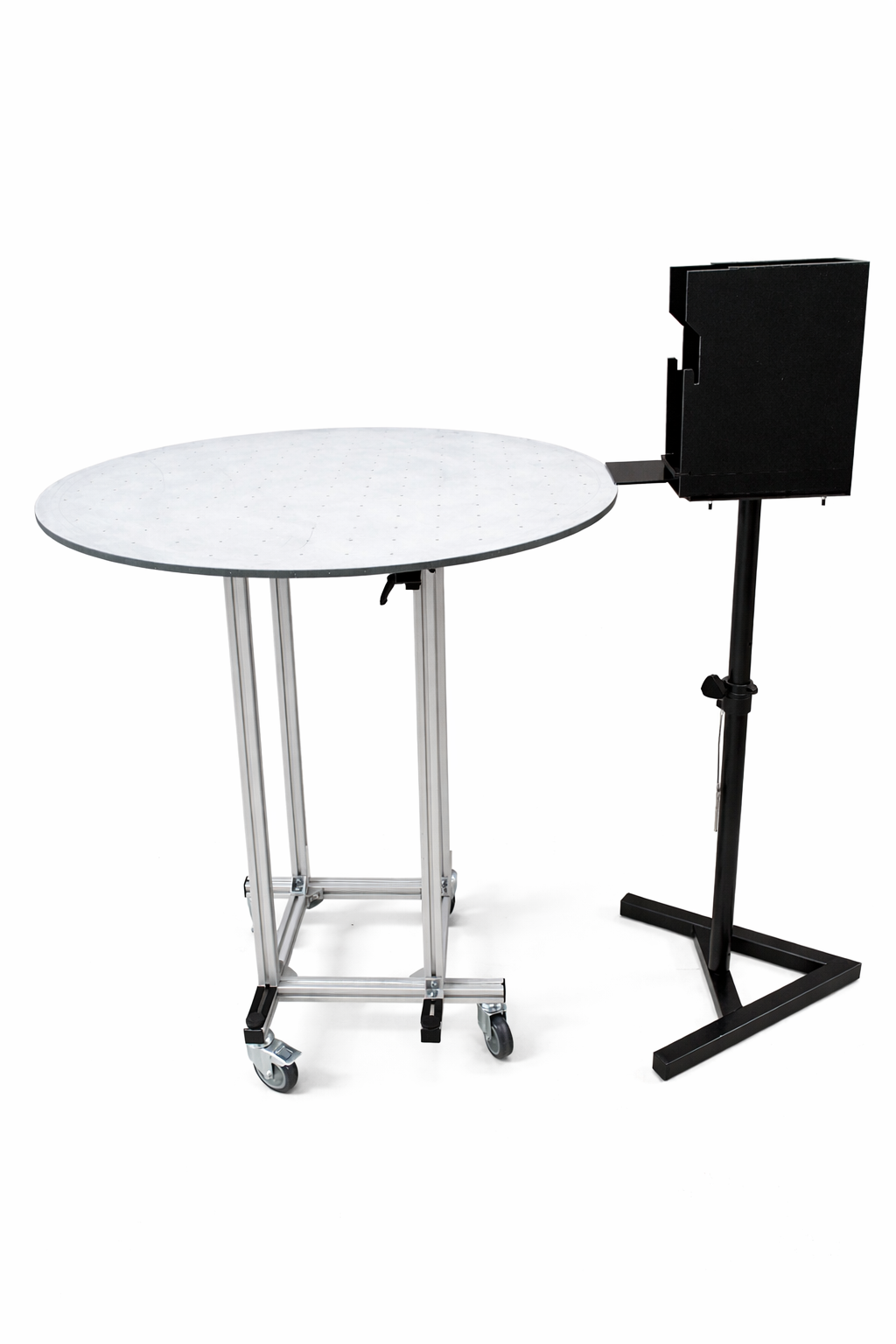
Cheeseboard Maze
Behavior
The Cheeseboard Maze is a high-precision experimental platform designed to study spatial navigation in rodents. It is developed according to the specifications described in the paper by Roux et al. in Nature Neuroscience, 2017:
--> Sharp wave ripples during learning stabilize the hippocampal spatial map
General Overview
This system consists of a rotating circular PVC maze mounted on a mobile aluminum cart, combined with an adjustable Start Box. It enables reproducible spatial learning and memory experiments while offering a high degree of experimental flexibility.
Key Features
- 80 cm diameter rotating circular platform with 177 wells
- Machined PVC surface with an indexed alignment system
- Mobile aluminum profile cart with locking wheels and foldable arms
- Dedicated Start Box with adjustable height and removable barrier
- Smooth rotation minimizing friction on the platform
- Compatible with allocentric and egocentric navigation protocols
Applications
- Spatial learning and memory studies
- Hippocampal research
- Analysis of navigation strategies
- Behavioral neuroscience protocols
Included Components
- Mobile aluminum cart
- PVC platform
- Telescopic stand and shaft
- Start Box with acrylic barrier
| Specification | Value |
|---|---|
| Platform size | 80 cm de diamètre |
| Platform thickness | 1 cm |
| Wells size | diamètre 4 mm | profondeur 1,5 mm | volume 5–15 µL |
| Number of wells | 177 |
| Start Box | Ajustable pour maintenir un dégagement d’environ 1 mm au-dessus du plateau |
| Trolley | Mobile en profilé aluminium avec roues freinées et bras pliables |